
MDOC Statewide Release Routes
A Leake County conviction can lead to confinement at any MDOC institution or contract bed. The conviction county does not fix the assigned institution. MDOC classifies and moves people within its system, and the public detail may show a new unit and location-change date. Those moves remain state custody. A person is not released to the community merely because a Leake County roster or one prison listing no longer shows the person.
There are three main community-facing outcomes. Parole is a discretionary release from prison after a Parole Board decision and subject to conditions. ERS, short for Earned Release Supervision, is a separate supervised route under Mississippi law. Maximum discharge marks completion of the computed term. Parole and ERS mean the person is physically out of prison but still under MDOC authority. A transfer means the person remains confined.
| MDOC event | What it means | Confirmation source |
|---|---|---|
| Institution transfer | Continued MDOC confinement at another site | Inmate Search location and movement record |
| Parole | Conditional community release after Board action | Board decision, Parolee Search, MDOC release record |
| ERS | Supervised community placement under MDOC | Time computation and Community Corrections |
| Maximum discharge | Computed sentence obligation ends | Official MDOC discharge record |
Confirm MDOC Statewide Releases
The MDOC number is the best search key. Names can repeat, change, or be entered in more than one form. Search the official inmate tool first, open the full detail, and compare identifiers. Read status and location with sentence fields. Then use the separate parole tool. Neither search should be treated as a complete public archive of every fully discharged former prisoner.
- Open the MDOC Inmate Search and enter the MDOC ID, or use the exact first and last name.
- Select the correct person and verify the photograph, conviction county, offenses, sentence dates, and current location.
- Read the exact “Tentative Release” field. Record the check date because the computation may change.
- Search the MDOC Parolee Search by ID or name, with city or county only as additional filters.
- If neither result establishes the legal status, ask MDOC Records for the release or discharge date, type, and time computation.
A negative result can reflect spelling, scope, a completed public profile, or another mismatch. It does not prove discharge. The Leake County release-record search path adds the sheriff and court channels when it is unclear whether MDOC ever accepted the person.
MDOC Release Search Fields
The public offender detail commonly shows identifying data, a photograph when available, current location, a location-change date, offenses, county of conviction, sentence length, sentence date, and Tentative Release. These fields should be read as a group. A past tentative date beside a current prison location is not an actual release. An empty field is not proof that the person served the sentence or left MDOC authority.
| Field | Release-record use |
|---|---|
| MDOC ID | Links the person across custody, sentence, and parole records |
| Location | Shows a reported institution or community status |
| Location-change date | Helps distinguish a transfer from an older placement |
| Tentative Release | Displays a provisional computed date, not a release certificate |
| Conviction county | Connects a statewide sentence to the Leake County case |
| Offense and sentence | Identify the term being calculated |
The official MDOC search form shows the current name and identification search route.
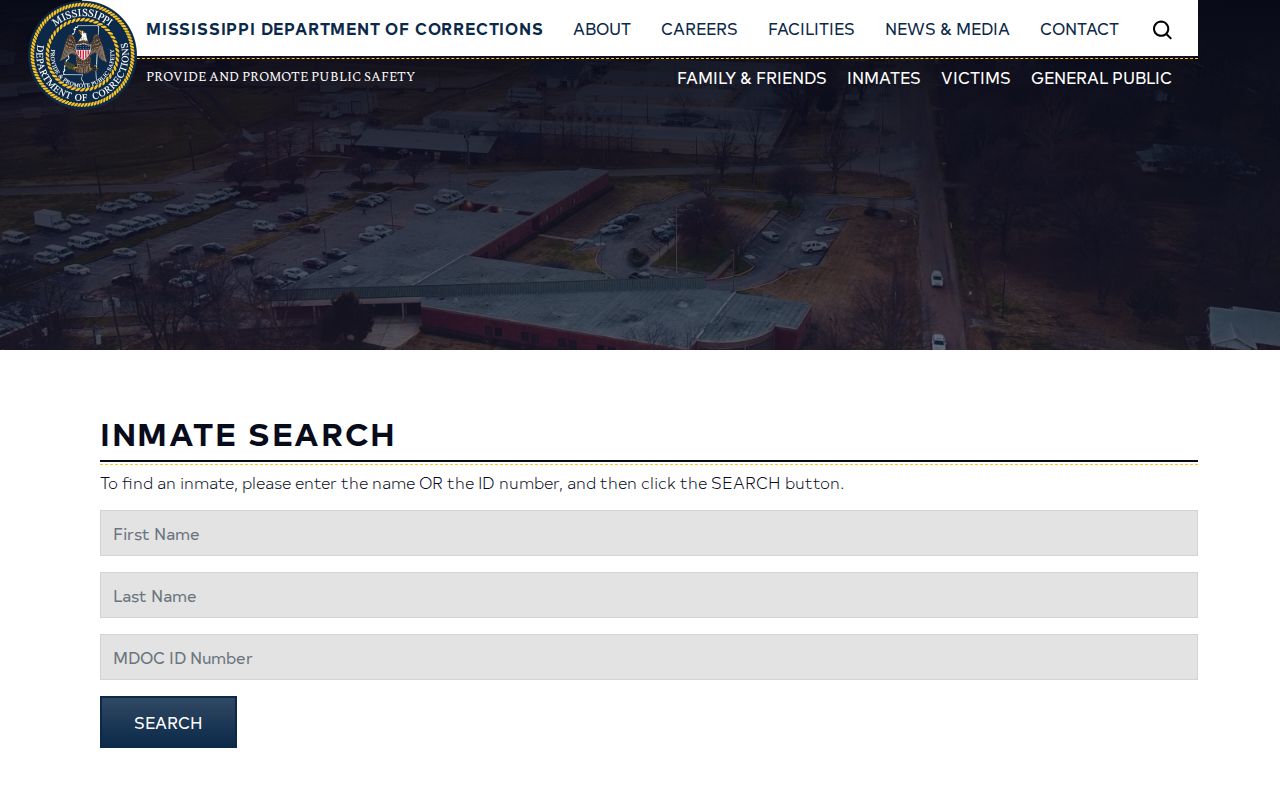
The captured form is an entry point. The full matching detail and agency record provide the context needed to distinguish an estimate, transfer, supervised release, and final discharge.
MDOC Statewide Release Records Contact
MDOC Records is the official fallback when the public searches do not show enough detail. Identify the person by exact name and MDOC number. Add the Leake County conviction when known. Ask for the precise material needed, such as a face sheet, time computation, release or discharge date and type, or photograph. MDOC may withhold or redact security, medical, personal, or other exempt information.
Mississippi Department of Corrections Records Department
Email: MDOCRecordsDepartment@mdoc.state.ms.us
Current telephone and mailing instructions: MDOC Contact
Constituent Services is an information and routing channel, not a substitute for a defined records request. For parole supervision, use the Community Corrections office tied to the current record. For a Parole Board decision, ask the Board for the named decision and effective or reconsideration date. Each office answers a different part of the release chain.
Note: Ask for the event type as well as the date so transfer, parole, ERS, and discharge remain distinct.
MDOC Tentative Release Records
MDOC uses the exact public label “Tentative Release.” The agency also computes an ERS date and a maximum release date when it receives a sentence. Tentative Release is an estimate based on the sentence structure, jail credit, lawful credits, eligibility limits, and department calculation. The maximum date is the computed full-term endpoint. ERS concerns a possible supervised transition and requires an acceptable residence plan.
Mississippi earned-time law is principally found in Miss. Code Ann. §§ 47-5-138, 47-5-138.1, 47-5-139, and 47-5-142. Eligibility can depend on the offense, offense date, sentence date, violent or nonviolent classification, habitual status, mandatory terms, conduct, classification, and other laws. The statutes have changed. No single 85 percent formula applies safely to all MDOC prisoners.
Dates may move after corrected jail credit, amended sentences, a ruling on concurrent or consecutive terms, a new detainer or sentence, disciplinary loss or restoration of credits, a parole decision, residence-plan review, or a data correction. Save the check date and confirm again near release. After the event, obtain the release or discharge record rather than relying on the earlier projection.
LEAKE CCF Release Record Fork
Leake County’s correctional complex has a dual identity that affects statewide searches. MDOC records can use “LEAKE CCF” as a location, while the Leake County Sheriff also operates the local jail function. The same building name can therefore appear in two very different legal custody paths. Not every person at the complex is an MDOC prisoner.
Start with the identifier. A local booking number points toward the sheriff’s jail docket. An MDOC number points toward the statewide inmate detail and MDOC Records. A county detainee may leave on bond, court order, time served, or transfer. An MDOC prisoner may transfer within the state, enter parole or ERS, or discharge. Applying the wrong search can turn a routine transfer into a false release claim.
When the county sends a person into MDOC custody, obtain the sheriff’s transfer entry and then follow the MDOC number. The county event ends local custody but not confinement. If the state later releases the person, MDOC controls that later record. The two entries form a custody chain rather than duplicate proof of one release.
Walnut Grove MDOC Release History
Walnut Grove Correctional Facility adds a second Leake County search trap. It was established in 1990, operated privately from 1996, closed in 2016, and reopened under MDOC in November 2021. Current MDOC material identifies it as an active state prison with a stated capacity of 1,496. Older search results may still call it closed or private.
Use the current MDOC facility source and the person’s offender record. A movement from Walnut Grove to another MDOC prison remains a transfer. Parole, ERS, and maximum discharge must be traced in state records. The original Leake County court or jail cannot certify the later MDOC release just because the sentence began with a local case.
The dedicated Walnut Grove release-record page provides the prison contact, history, state-search steps, and the distinction between a unit departure and community release.
Note: Current MDOC records control when old Walnut Grove directory descriptions conflict with the reopened state prison.
MDOC Supervised Release Records
The Mississippi State Parole Board decides parole. MDOC Community Corrections supervises parolees, probationers, ERS participants, and other community cases. A parole grant may come before residence approval, detainer review, conditions, and physical processing. First eligibility is also not a promise of release. Confirm the written decision, then check the parole record after the expected date.
The official MDOC Parolee Search is separate from the custody-oriented inmate search.
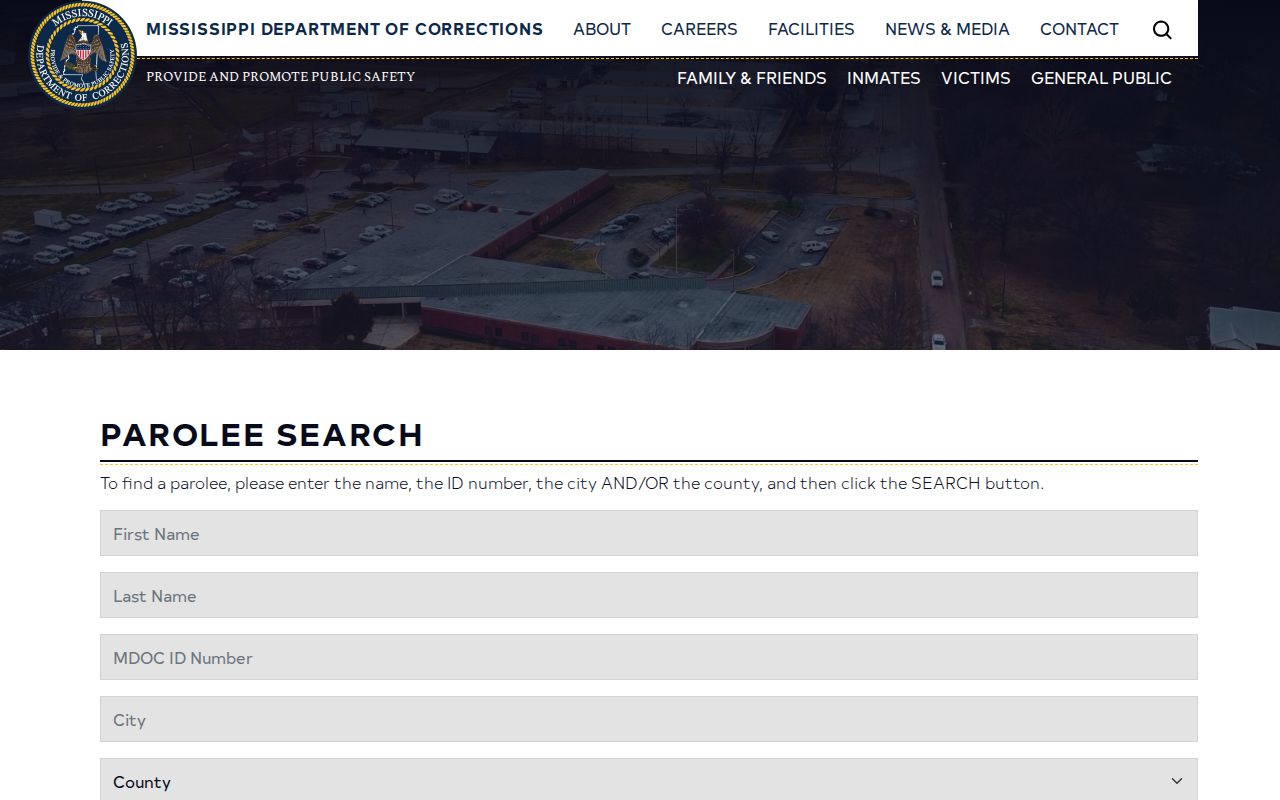
The separate interface reinforces the need to check both systems. A community result can support parole status, while the inmate detail preserves sentence and location context. Neither alone replaces an official discharge record.
Supervision office assignment follows the case and approved residence. It should not be guessed from Leake County conviction alone. An ERS participant remains under MDOC jurisdiction until the sentence endpoint and may be returned for a violation. A parolee likewise remains subject to the sentence and conditions. Record the prison release date, release type, supervision status, and final discharge as separate events.
If the expected date passes, reopen both live searches before drawing a conclusion. A prison location can mean release was delayed or the calculation changed. A parole record can confirm movement into parole but not the later end of supervision. When neither interface resolves the sequence, request the time computation and discharge record. Preserve the exact terms MDOC used and the date each source was checked.
Mississippi VINE may provide a custody-change notice for a participating MDOC record, but a notice is secondary evidence. Transmission can lag, and the event wording may omit the sentence basis or later supervision. MDOC’s source record remains the controlling proof for a state release or discharge.