
Federal Bureau Release Record Scope
The Federal Bureau of Prisons is a nationwide correctional system, not a physical Leake County facility. A federal defendant tied to Leake County may be housed in any BOP institution. The county sheriff’s roster cannot certify a later federal release. Likewise, leaving Leake County jail after a federal pickup only confirms the end of county custody. The U.S. Marshals Service, a contracted jail, or BOP may hold the person next.
The BOP Inmate Locator covers federal inmates from 1982 to the present, plus some older records. A former federal prisoner may appear with “Released” and a release date or with wording such as “Not in BOP custody.” Preserve the exact label. BOP warns that dates can change through sentence review or recalculation, and its status is limited to BOP custody.
| Displayed result | What it establishes | What it does not establish |
|---|---|---|
| Current BOP institution | The matched person is reported in BOP custody | No county jail release time or future guaranteed date |
| Released and a date | BOP reports the end of its physical custody | No promise that another custodian or supervision is absent |
| Not in BOP custody | BOP does not report current physical confinement | No complete legal status or destination |
| No match | The search did not return the intended record | No proof of release, no federal case, or a completed sentence |
Federal supervised release is a court-ordered community term that can follow prison. It is distinct from Mississippi parole or probation administered through MDOC.
Confirm Federal Bureau Releases
Start with the strongest identifier available. A federal register number is better than a name because names and spellings can overlap. The locator also accepts DCDC, FBI, and INS identifiers, or a biographical search. Open the matched record and record the wording and date rather than translating the result into “free” or “fully discharged.”
- Open the BOP locator and choose an identifier search when a register, DCDC, FBI, or INS number is known.
- Otherwise search by the full name and the available age, race, and sex fields. Compare every identifier on the result.
- Read the status and release date exactly as displayed. Save the date and time checked because sentence data can change.
- Review the federal court docket for the sentence, later orders, and any term of supervised release.
- When release method or destination matters, request the BOP release or arrival record and ask the responsible office to identify any detaining agency.
- If county custody came first, obtain the Leake transfer entry separately. It can identify the federal custodian that received the person.
The locator is a search tool, not a certified release document. The Leake County released inmate search provides the local custody fork when it is unclear whether a person ever entered federal custody. Do not start with BOP for an ordinary county bond release.
Note: One federal release date can describe the end of prison while a court-ordered community supervision term remains active.
Federal Inmate Locator Record Fields
BOP offers two main ways to search. The identifier route can use a register, DCDC, FBI, or INS number. The biographical route uses the name with age, race, and sex filters. Identifier searches reduce the risk of choosing the wrong person. A Leake County case number is not one of the listed locator identifiers, so obtain the federal register number from the docket or another official record when possible.
| Register number | The primary BOP identifier for a federal inmate record |
|---|---|
| DCDC, FBI, or INS number | Alternative federal identifiers accepted by the locator |
| Name | A biographical starting point that may return more than one person |
| Age, race, and sex | Filters used to narrow a name search |
| Status and release date | BOP’s public statement about its custody record |
A correct identifier does not make the public result complete. It may omit the release method, destination, detainer, or supervision term. Use the record as a lead, then request the source document or consult the federal docket for the missing part.
Federal Bureau Release Search Screen
The official Federal Bureau of Prisons locator shows the identifier and name-search paths used for a nationwide release check.
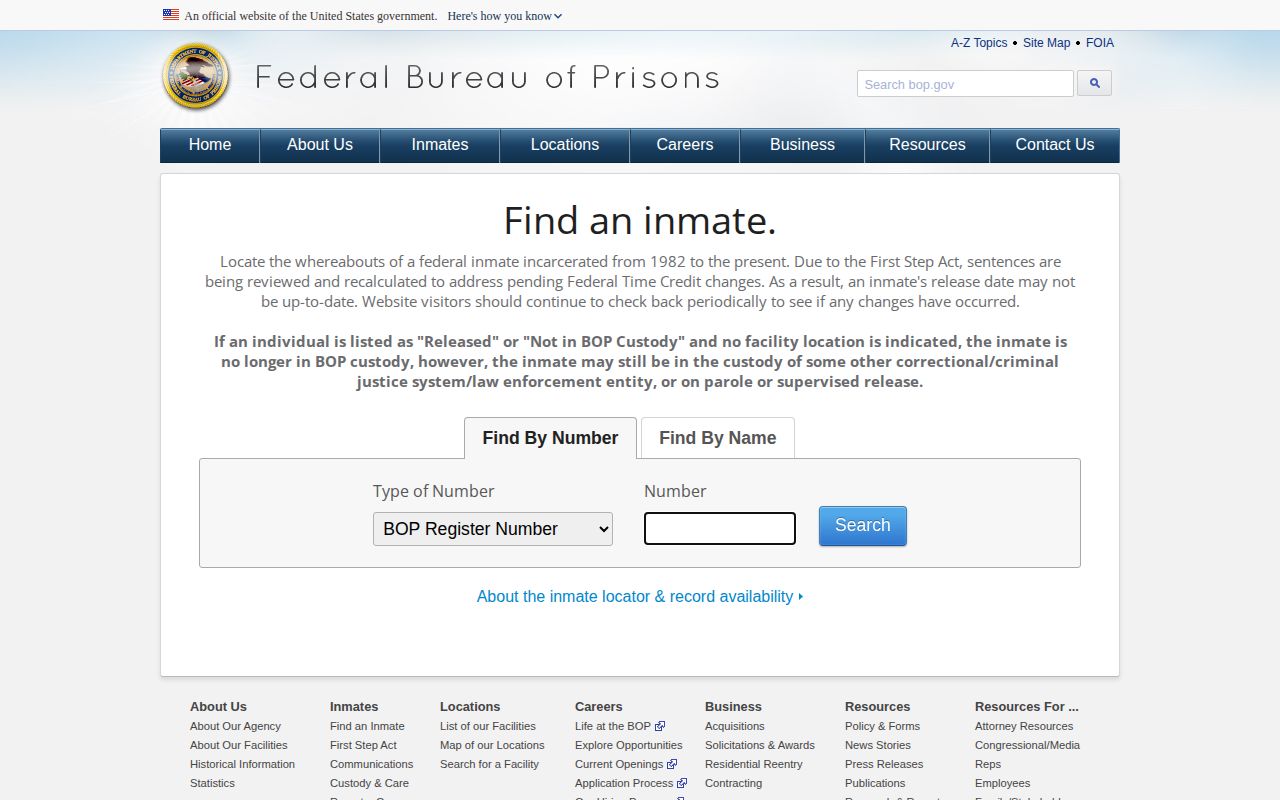
The screen is an interface example, not evidence about a named person. Match the result to the federal identifier and preserve BOP’s exact custody wording before seeking the underlying record.
A federal search may return a person long after release because the locator maintains historical information within its scope. That differs from a live county roster, which is built around present jail custody. It also differs from ICE’s locator, which primarily addresses current immigration detention.
Federal Release Status Record Limits
“Released” means release from BOP custody. “Not in BOP custody” is also limited to BOP. Either result can coexist with another correctional or law-enforcement custodian, a detainer, or federal supervised release. A detainer is a request or notice from another authority that can affect where a person goes when the first custodian ends confinement.
BOP’s Notice of Release and Arrival form, BP-A0714, illustrates the missing context. It includes the release method, institution, community destination or detaining agency, destination, and supervision information. Those fields show why a locator label alone may not answer where the person went. Ask BOP for the applicable record or consult the federal docket when destination matters.
A release date can also change through recalculation. Record the date checked, compare the current result close to the event, and obtain the completed release record afterward. Do not turn a projected date into a guaranteed pickup time.
Federal Bureau Release Record Requests
Use BOP records and the federal court docket when the public locator does not answer the release method, destination, or supervision question. Identify the person by full name and register number. State the exact document or field sought, such as the actual release date, release method, institution, detaining agency, destination, or Notice of Release and Arrival.
Federal Bureau of Prisons
Nationwide federal custody and release records
The federal docket can establish the judgment, sentence, later amendments, and supervised release term. It may not state the minute physical custody ended. BOP supplies the correctional event. When the two sources answer different questions, retain both rather than treating one as a substitute.
If the locator result appears wrong, include the register number and the conflicting court or agency document in a focused inquiry. Avoid calculating a federal release date from the sentence alone. Credits, later orders, and recalculation can change the public date.
USMS Federal Transfer Records
The U.S. Marshals Service moves and houses federal pretrial prisoners and people awaiting designation. It may use local or contracted facilities. USMS does not provide a broad public historical inmate locator comparable to BOP. A person can therefore leave a Leake County roster in federal custody without appearing immediately as a sentenced BOP prisoner.
Use the federal court order to identify the case, then identify the responsible detention facility or later BOP number. The official USMS prisoner information describes the agency role, while the facility or BOP record confirms the physical custody event. If the Leake County jail handed the person to USMS, the county entry is a transfer, not community release.
The custody chain should show each handoff: Leake County, USMS or a contracted detention site, BOP if designated, and then release or another custodian. A gap in one public search is not evidence that the entire chain ended.
LEAKE CCF Federal Release Fork
Leake County's dual-use facility makes the first custody label especially important. MDOC may show “LEAKE CCF” as a state location, while the Leake County Sheriff also operates the local jail function. Neither label establishes federal custody. A local booking number belongs with the sheriff record, and an MDOC number belongs with the state system. A federal register number or a federal court record is needed before the BOP route becomes the right search.
If USMS or another federal authority receives a person from Leake County, request the sheriff's transfer entry and identify the receiving agency. Then use the federal case and identifier to follow the next placement. This custody fork preserves Angle T's local distinction: the building name never replaces proof of which agency had legal custody, and leaving LEAKE CCF does not by itself prove release into the community.
Walnut Grove Federal Release Contrast
Walnut Grove Correctional Facility is an active MDOC state prison, not a BOP institution. Its closure in 2016 and reopening under MDOC in November 2021 can leave stale “closed” or private-operator descriptions in search results. Current custody and release questions for Walnut Grove belong in MDOC Inmate Search, Parolee Search, and MDOC Records unless a separate federal case or transfer record proves that federal custody followed.
A move from LEAKE CCF to Walnut Grove is a state transfer, not a federal release and not community freedom. Angle L's history matters because an old facility listing can send a search to the wrong system. Use the current MDOC record for the state movement. Reserve BOP's “Released” or “Not in BOP custody” wording for a matched federal record with the correct federal identifier.
ICE Records Differ from BOP
ICE civil immigration custody is distinct from BOP criminal custody. The ICE Online Detainee Locator System is mainly a current-custody locator. It can search by a nine-digit A-number and country of birth, or by exact biographical details. It does not serve as a reliable public historical release archive.
A missing ICE result may reflect transfer, removal, release, incorrect identifiers, a data delay, or a scope limit. It does not prove community release. ICE does not support locator searches for minors, and its public scope differs from BOP’s historical federal prisoner coverage. Use the relevant detention information channel and immigration records when a person stops appearing.
If Leake County transferred someone to ICE, the sheriff record should be read as release from county custody to another agency. The same rule applies to a BOP detainer destination. Ask which custodian received the person, then use that system’s record. This avoids turning an agency handoff into a false claim of freedom.
Note: BOP, USMS, and ICE each answer a different custody question, even when the same person moves through more than one system.
Public Record Search
Sponsored Results